
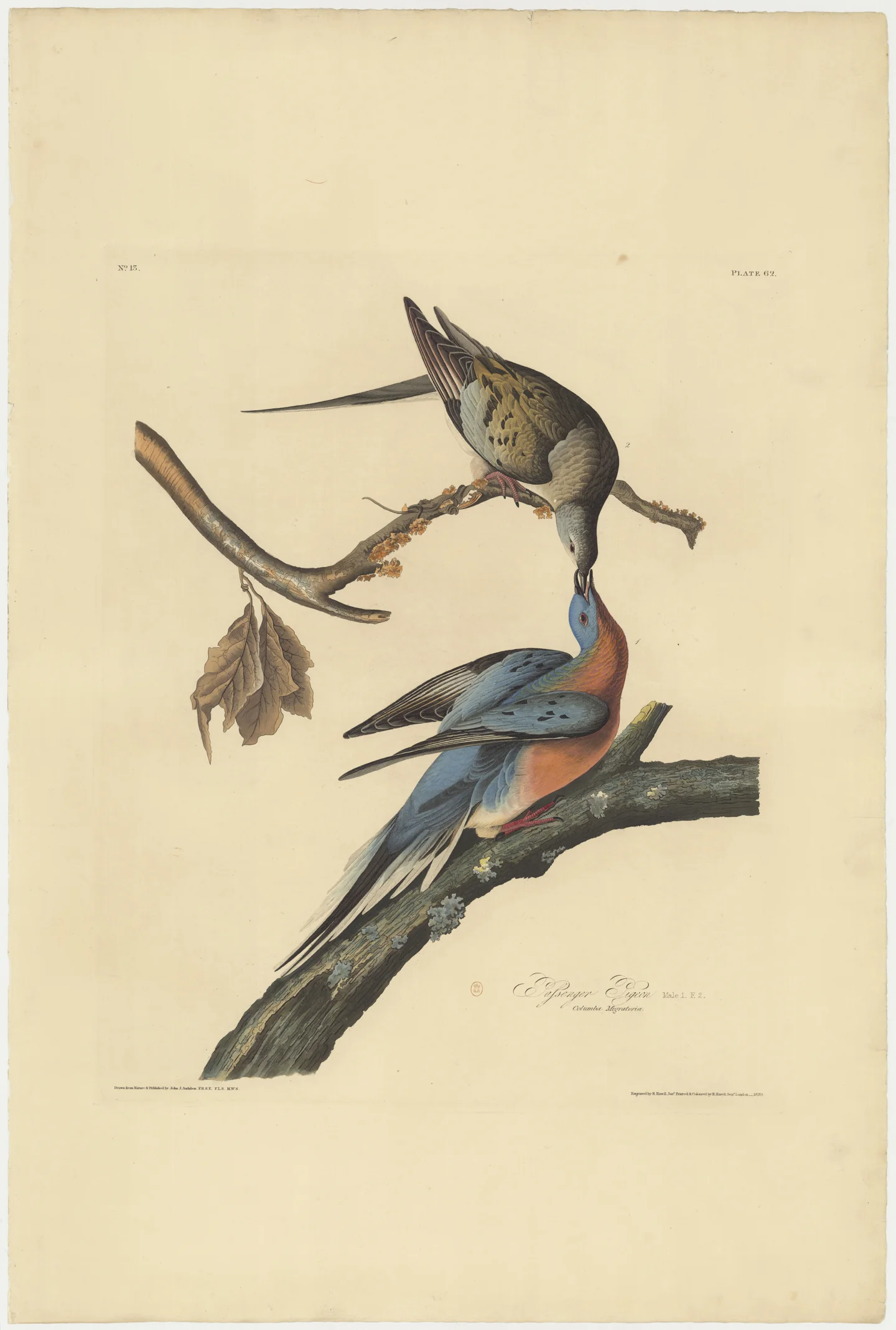
The passenger pigeon / Ectopistes migratorius
Once, they filled
the sky.
I / The wonder
Billions of birds.
Flocks so immense they darkened the midday sky.

Estimated peak North American passenger pigeon population [1]
The sky kept moving.
In the autumn of 1813, John James Audubon watched passenger pigeons pour across the Kentucky sky in numbers that defeated his attempt to count the flocks. Writing years later, he recalled his own amazement at the sight.
Daylight darkened beneath them, and the continuous sound of wings filled the air. By sunset, the birds were still passing over Louisville. Audubon reported that they continued in undiminished numbers for three successive days. [2]
Ohio witnessed migrations on a similar scale. Project Passenger Pigeon recounts a flock passing over Columbus for most of a day in the spring of 1855. Its estimated length was ninety miles—a measure of the vast passage witnessed from the city. [3]
Kentucky, autumn 1813
“the light of noon-day was
obscured as by an eclipse”
Recounting his observation of the 1813 migration

II / The disappearance
So many.
Then so few.
Abundance offered no lasting protection. In the second half of the nineteenth century, intensive commercial hunting and the destruction of forests drove a rapid collapse.
Birds were killed in enormous numbers and shipped to city food markets. At the same time, forest clearing removed habitat and food sources. The great gatherings that had astonished observers made easy targets for hunters.
Within a few decades, the immense flocks had become scarce. Within a human lifetime, abundance had given way to absence. [4]
III / The last passenger pigeon
Martha.
September 1, 1914 · Cincinnati, Ohio
At the Cincinnati Zoo, Martha, the last known passenger pigeon, died. With her, Ectopistes migratorius became extinct.
Her body was sent to the Smithsonian for preservation. No living passenger pigeon remained; the immense migrations belonged to history. [1]
IV / What we remember
Valuable things deserve
thoughtful stewardship.
We chose Ectopistes as a reminder to consider what we make, what we use, and what we might take for granted. In our work, that means respecting people’s privacy, preserving simplicity, and building technology with care for its long-term consequences.
A company name cannot change this history. It can help us remember what we want our work to stand for.
Return to Ectopistes